How to Start a Pressure Washing Business: Scope, Costs and First Customers
Start a pressure washing business by choosing a surface you can clean competently, checking local operating and wastewater requirements, and pricing the whole visit. Build an equipment budget around that service. Then seek customers inside a manageable area, inspect each proposed job and agree the work in writing before accepting it.
The decision is whether you can deliver a defined cleaning service at a price that covers its costs. Owning a machine answers only part of that question. This guide helps you work through the business decisions, from a first service offer to repeatable bookings.
Choose the pressure washing service you will sell
Property owners and managers may need exterior hard surfaces cleaned. A driveway, a paved entrance and a commercial walkway can involve different access, scheduling and cleanup arrangements. Start with a specific surface and customer group rather than advertising that you clean everything outside.
Write a short offer: the surface you handle, the area you cover, how a customer requests an assessment and which work you exclude. For example, a proposed ground-level paving service might exclude roofs, elevated work, paint removal and repairs. That is a possible business boundary, not a claim that every paved surface is suitable for pressure washing.
Surface suitability comes before a sales promise. Find the surface or coating manufacturer's cleaning instructions and the equipment manual. If you cannot establish a suitable method, decline that part of the request or refer it to an appropriately qualified provider. Buying a more powerful machine does not resolve an uncertain material or damaged finish.
Ask prospective customers what they want cleaned and what prompted the request. Distinguish a general appearance concern from an oil spill, damaged coating or another problem requiring specialist assessment. Record the requested outcome without guaranteeing that a particular stain will disappear.
Learn the work before buying a complete setup
Arrange practical training appropriate to the work you intend to offer. Read the machine's operating and maintenance instructions, learn its limits and obtain supervised practice where available. Get permission for any practice area; free work still needs a defined scope and an agreed response to damage.
The CDC's pressure washer safety guidance identifies serious spray injuries, flying debris, electric shock and carbon monoxide as hazards. It says to follow the owner's manual, keep the spray away from people and keep children away from operation. A high-pressure spray wound needs prompt medical attention even if it looks small.
For gasoline-powered equipment, CDC says never to operate in an enclosed space or within 20 feet of a window, door or vent. Its electrical precautions include testing the ground-fault circuit interrupter and keeping cord connections away from standing water and runoff. These points are a starting check; the machine's instructions and the conditions of the site still matter.
Do not add high-level work simply because a customer asks. Keep the launch service inside your training, equipment and insurance scope. If the proposed job needs different access arrangements or specialist cleaning, reassess the whole job before quoting.
Check local permissions, insurance and wash-water disposal
Find the business registration and licensing offices for the place where you will operate. Ask which requirements apply to your planned cleaning activities and whether working across a city or state boundary changes them. The U.S. Small Business Administration's launch guide explains that requirements depend on business activities and location. Outside the United States, use the relevant local authorities.
Describe the actual work to an insurance agent, including the surfaces, access methods, cleaning products, transport and any helpers. Ask what is covered, excluded and subject to conditions. SBA identifies general liability as a common category covering risks such as bodily injury and property damage; that description does not establish that a particular pressure washing job is insured. Confirm your own policy before taking a booking.
Wash water needs a plan before cleaning starts. As one specific U.S. example, Portland's pressure washing rules prohibit pressure-washing wash water from entering its stormwater system. The city also requires approval for sanitary-sewer discharge and describes a Mobile Washer Discharge Authorization. Those are Portland requirements, not a rule for every location.
Ask the local wastewater or stormwater authority how to contain, collect and dispose of the water from your proposed service. Explain the surface, contaminants and products involved. Do not treat a customer's permission to use a drain as regulatory approval. Confirm local water-use restrictions and any rules affecting the cleaning chemicals you intend to use as well.
Keep the replies, authorization conditions and renewal dates with your operating records. If you do not yet have an acceptable disposal route for a job, resolve that question before selling it.
Build a budget for the complete service
Prepare two lists: costs needed to begin operating and costs that recur with each job or month. Obtain current supplier, rental and insurance quotations for your own area. A machine-only price leaves out decisions that can change whether the service is affordable.
- Cleaning equipment: a suitable machine, compatible hoses and attachments, maintenance items and protective equipment required for the work.
- Site and water arrangements: access to a permitted supply, containment or recovery equipment, and approved disposal arrangements where required.
- Transport and storage: a suitable way to secure and move equipment, travel costs and a permitted place to keep it.
- Business overhead: registration, insurance, communication, payment processing, bookkeeping and marketing.
Ask a rental supplier whether the intended commercial use is permitted, which accessories are included, what happens if equipment fails and what damage charges apply. Compare that complete arrangement with ownership costs. Renting can help evaluate a service before a larger purchase, but it is useful only if the equipment and availability fit the work.
Keep a reserve for maintenance, rescheduling and work that takes longer than expected. Avoid committing to a full season of equipment payments on the strength of enquiries alone. An enquiry, an accepted quote and a paid completed job are different records.
Price a pressure washing job from the whole visit
Inspect the location before giving a firm price whenever photos leave important questions unresolved. Confirm the surface, approximate area, access, existing damage, water arrangements, nearby people or property, and where the wash water will go. Ask who has authority to approve the work.
Estimate time for travel, setup, cleaning, recovery, disposal, packing away and customer handover. Add direct costs and a share of overhead. The price must also support your pay and the business's remaining obligations; money collected from a customer is not all available earnings.
You can express the final quote as a project price or a rate linked to a defined area. Whichever format you use, state the measurements, inclusions and assumptions. A per-area rate without material and access limits can describe two very different jobs as if they were identical.
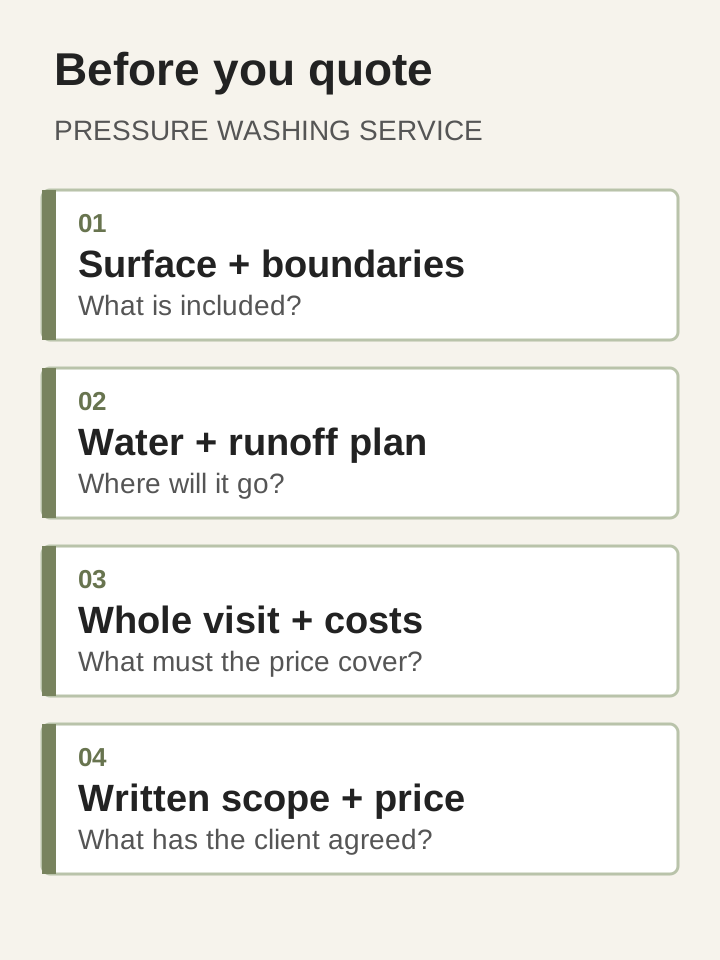
Use this quote worksheet before accepting a booking:
- Identify the surface and boundaries. Name the areas included and excluded; note unresolved condition questions.
- Confirm the site plan. Record access, water supply, work-area controls and the approved wash-water route.
- Calculate the complete visit. Include all working time, direct expenses and overhead rather than cleaning time alone.
- Agree the written price. State the service, payment terms, scheduling conditions and how extra work is approved.
After each completed job, compare estimated time and direct costs with the actual record. If setup or disposal consistently takes longer, revise the estimate for similar work. Do not hide those hours when deciding whether the service is paying adequately.
Find first customers inside a workable area
Choose a travel area you can serve reliably and describe the surface you actually handle. A useful enquiry page shows the service boundary, contact method and information needed for an assessment. The local service flyer guide helps turn that offer into a short message.
Start with permitted local outreach, relevant community listings and relationships with property managers or adjacent service providers. Check each channel's advertising and solicitation rules. Ask how a customer found you so you can compare channels against completed work and marketing expense.
Use your own job photographs only with appropriate permission. Keep the same framing and describe the work accurately. Avoid editing a photograph to exaggerate the cleaning result or using a stock image as proof of your work. If you do not yet have a portfolio, show your service description and assessment process while building one honestly.
Request feedback after the customer has had an opportunity to review the work. A referral arrangement should identify who supplies the service and who handles the enquiry; the small-service referral guide covers that conversation. Do not promise instant availability if travel or equipment bookings still need checking.
Run each booking with a clear handover
Before arrival, reconfirm the appointment, person authorizing access and agreed work. Check whether changed weather or site conditions affect the plan. On arrival, document existing condition with permission and pause if the actual surface or access differs from the quotation.
Agree any additional work before doing it. Use a project change log to record the request, price or time effect and approval. This is particularly useful when a customer adds another area while you are already on site.
At handover, identify the areas cleaned and any agreed work left outstanding. Follow the applicable product and surface instructions when communicating any precautions or return-to-use conditions. Send an invoice matching the approved scope and keep the job's cost and payment record.
Review the schedule as a whole. Leave room for equipment care and weather disruption rather than treating every available hour as a sellable cleaning hour. Ask customers whether they want a future reminder without assuming that every property needs the same cleaning interval.
Is a pressure washing business a suitable side hustle?
It can suit someone who wants local service work and can handle the physical tasks, equipment care, customer communication and site planning. Check demand in your proposed area before buying a large setup. Climate, water restrictions and customer schedules can all affect the work you can accept.
Compare it with a service that fits different skills or equipment. Mobile car detailing involves vehicles and their specific cleaning needs. Home cleaning has a different work setting. Read the window cleaning scope guide if that service fits your experience better. Each still needs its own safety, operating and cost checks.
Questions before you launch
How much does it cost to start a pressure washing business?
Build the answer from local quotations for your defined service. Include transport, insurance and water recovery or disposal arrangements as well as the machine. The budget section above is a purchasing checklist; it does not imply a universal startup amount.
Do you need a pressure washing business license?
Check the authorities for your location and activities. Business registration, operating permissions, water use and wastewater disposal are separate questions. Approval for one does not answer the others.
How much can you earn pressure washing?
Use your own prices, completed bookings, expenses and total working hours to evaluate that. Before launch, a costed quote is a planning tool rather than an earnings result. Keep sales, business costs and personal pay separate when you review the numbers.
What should your first paid job be?
Choose work that fits your demonstrated skills, equipment, insurance and confirmed site arrangements. A manageable scope with clear access and disposal is more useful for evaluating the business than a large job with unanswered conditions.
Research checked November 17, 2026. Further reading: Side Hustle Nation's pressure washing business guide.