
How to Start a Lawn Care Business: Build a Route Before You Build a Fleet
Start a lawn care business with a defined service, a small service area and a quote that covers the entire visit. Check the equipment and local requirements before accepting work, then use completed-job records to improve your prices. Buy additional capacity when a reliable route can support it.
A mower is only part of the business. You also have to get it to the property, handle a locked gate, decide what happens to clippings and collect payment. Those details determine whether a busy afternoon leaves enough money to maintain your equipment and pay you.
Choose the lawn care service you can deliver consistently
Begin with an offer you can explain in one sentence: routine mowing and agreed edge tidying for accessible residential lawns within a defined area. Adjust that offer to your actual skills and equipment. Avoid advertising a full landscaping service simply because someone might request it.
Your first service menu should answer four questions:
| Decision | What to agree |
|---|---|
| Work included | Which lawn areas, edges and hard surfaces are covered? |
| Condition accepted | Is this maintained grass or a separate overgrown-yard assessment? |
| Material handling | Are clippings left appropriately, collected on site or removed? |
| Visit conditions | How are access, pets, parked vehicles and unsuitable weather handled? |
An initial cleanup and a repeat maintenance visit can require different amounts of work. Quote them separately when the difference matters. Otherwise, the first difficult visit becomes the price the customer expects indefinitely.
Treat tree work, irrigation repairs, excavation and chemical treatments as separate services. Each can change the skills, equipment, insurance and permissions you need. A narrower menu is useful when it keeps your promise understandable and repeatable.
In the United States, the EPA explains pesticide-applicator certification: restricted-use pesticide work has certification requirements, and many states require certification for all commercial applicators. Check the relevant authority before offering treatments. A mowing service does not establish permission to apply pesticides.
Test a compact service area before spending heavily
Pick an area you can serve within the hours you actually have. If this is a weekend business, a distant customer who needs weekday visits may be a poor match even at an attractive price.
Read local providers' public service descriptions. Look for the work they offer, the areas they serve and the information they request before quoting. Then talk to potential customers about their practical problem: irregular visits, unclear scope, inaccessible booking or a lawn too small for a larger contractor's minimum job.
Those conversations are research. A person saying they like your idea isn't the same as an accepted booking.
Use one simple enquiry process. Ask for the address, approximate lawn size, current condition, access width and requested work. Photos can help you prepare, but they don't show every obstacle or prove the ground is suitable for equipment. Reserve the right to revise or decline a job after assessing it, before work starts.
Keep the first route small enough that you can learn from it. Record why each enquiry was accepted, declined or lost. If most people want services outside your competence, change the offer or audience before buying more machinery.
Budget for the working business, including downtime
There isn't one honest startup price for every lawn care business. The equipment you already own, transport, service area and local obligations change the calculation. Build a written budget from actual quotes rather than a headline equipment total.
Separate purchases from the money needed to keep operating:
| Budget line | Include in your calculation |
|---|---|
| Equipment | Suitable mower, required hand tools, replacement parts and protective equipment |
| Transport | Safe loading and securing, storage, vehicle use and any trailer-related costs |
| Business setup | Registration, local permissions, insurance and payment arrangements |
| Operating reserve | Energy or fuel, repairs, consumables and bills due before customer payments arrive |
Buy for the jobs you have decided to offer. A large machine may save mowing time but create access, storage or transport problems. Check the narrowest accepted access and the manufacturer's operating limits before treating extra cutting capacity as a benefit.
Used equipment needs a separate inspection and repair allowance. A low purchase price is less helpful when a breakdown cancels a route you have already promised. Consider what you will do if the mower is unavailable: reschedule, arrange an appropriate replacement or refer the work elsewhere with the customer's agreement.
The U.S. Small Business Administration's launch guide covers business structure, registration, location-dependent permits and insurance. Use your own country's business authorities for local requirements. Ask an insurance professional about the actual services, equipment and vehicle use you intend to undertake; compare policy terms rather than assuming a policy name covers every job.
Price the whole visit, then check the actual time
A lawn that takes half an hour to mow doesn't necessarily create a half-hour job. You may also spend time driving, loading, speaking to the customer, preparing the site, tidying and invoicing.
Build each quote from your expected costs and time:
Quote basis = paid work time + travel and setup + equipment and material costs + allocated business overhead + a business surplus.
If someone else works with you, include their paid time too. Keep tax treatment appropriate to your location and distinguish money collected on behalf of a tax authority from your available earnings.
You can present a fixed visit price to the customer while estimating labor internally. What matters is that you know the assumptions behind that fixed price. Record the included work, initial condition, access requirements and how a requested change will be priced.
After completing a job, compare estimated time with actual time. A recurring gap is useful information. Perhaps unloading takes longer than expected, the gate creates delays or the property needs more edge work. Revise the next quote or the service description using that evidence.
Avoid quoting overgrown work as an ordinary repeat visit. Ask what you need to assess it properly and agree the initial work before offering a maintenance schedule.
Use a route record, not just a mowing timer
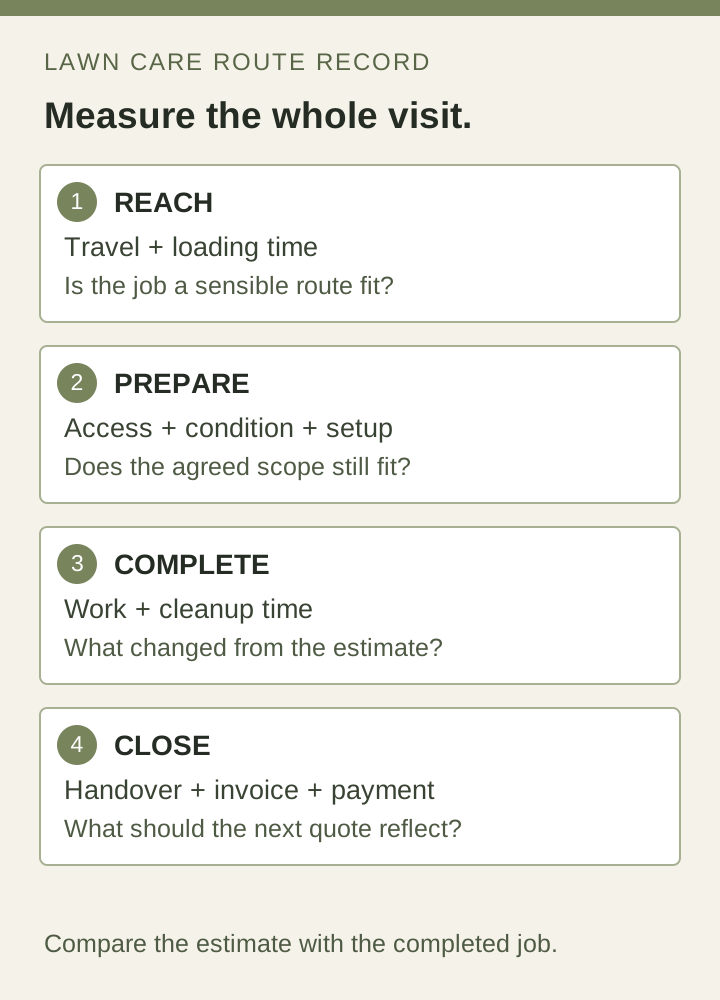
For each visit, record travel, setup, work, cleanup, payment status and any return visit. Keep the record brief enough that you will use it consistently. Permission-based condition photos may help resolve a specific concern; avoid collecting unnecessary images of the customer's home or belongings.
Compare similar jobs together. One unusually easy lawn shouldn't establish your price for every property. Equally, a single difficult visit doesn't prove the whole service is unprofitable.
When deciding whether a customer fits your route, consider the space around their visit. A nearby booking can fit between existing jobs; an isolated booking may require its own trip. Price and scheduling should reflect that difference without promising a particular profit margin.
Find the first customers with an offer they can verify
Make it easy to understand where you work, what you do and how to request a quote. A simple webpage or business listing can answer those questions without a large website project.
Start with an accurate description of your available service. If you distribute flyers or post in a community group, follow the location or platform's rules. Use photographs of work you have permission to show and describe only the services you can provide. Fovza's local service flyer guide helps turn the offer into clear wording.
Ask a satisfied customer whether they would pass your details to someone nearby. That is also an opportunity to develop a sensible route. Don't offer a time slot until you can actually accommodate it.
For paid marketing, decide in advance how much you can spend testing one offer. Track enquiries, accepted jobs and the money remaining after the work and acquisition costs. Clicks alone don't tell you whether the advertising supports the business.
If enquiries arrive but few turn into bookings, examine the conversation before increasing the advertising budget. Are you attracting the wrong area, leaving the scope vague or responding after the customer's decision? Each problem needs a different response.
Make repeat visits easy to manage
Agree the expected visit schedule and explain how weather, ground conditions, seasonal growth or unavailable access can change it. A recurring arrangement needs a workable rescheduling process, rather than a promise to mow regardless of conditions.
Before each visit, confirm anything that affects access or the agreed work. Afterward, tell the customer what was completed and flag work you could not carry out. Send the invoice through the agreed channel and record payment against that visit.
Keep a clear process for concerns. If the customer reports an unfinished area, compare it with the agreed scope and arrange an appropriate next step. Resolve the specific issue before turning it into an argument about the entire relationship.
Review repeat customers as a route. Check reliability of access, actual visit duration, payment timing and requests for extra work. A full calendar can still be difficult to sustain if every appointment leaves unpaid work behind it.
Add workers only when the work supports them
Hiring changes the business beyond the number of lawns you can service. It creates supervision, training, scheduling and employment obligations. Check local worker classification, pay, insurance and any age-related equipment restrictions before engaging anyone.
Write down the actual role. Include the work, equipment, expected availability, reporting process and who decides when conditions are unsuitable. Show a new worker the agreed service standard and check their competence before relying on independent visits.
The OSHA landscaping hazards guide identifies machinery, noise, chemical exposure, lifting and weather among the industry's hazards. Use relevant local safety requirements, equipment manuals and appropriate training to build the working method. This business plan is not equipment-operation training.
Calculate whether the extra work can support the worker's full cost and your management time. If bookings are inconsistent, a permanent expansion may be premature. Improve quoting and scheduling first when those are the real capacity problems.
Decide what to expand using completed-job evidence
At the end of your first operating period, examine four records: accepted quotes, actual visit costs, payments received and repeat bookings. Use them to decide whether to improve the current service, extend the route or add a separate service.
A second mower makes sense only when it solves a specific problem. A wider service area should account for extra travel. An added treatment service needs its own competency and permission checks. More options aren't automatically more useful to the customer or more profitable for you.
For the next booking, make one commitment you can keep: a clear scope, a realistic schedule and a price based on the work required. That gives you something concrete to measure before making the business bigger.
Sources and related reading
The Side Hustle Nation lawn care business article provides the same-topic business benchmark. This guide independently develops a route-first planning approach; individual founder income and market forecasts are excluded. The official U.S. sources linked above support the identified business, pesticide and workplace-safety checks. Local requirements must be checked for the place and services concerned.
For other ways to structure local work, compare Fovza's local earning routes and side hustle ideas.