
How to Start a Junk Removal Business: Price the Whole Job, Confirm the Disposal Route
A junk removal business needs a confirmed destination for the load before it needs a full calendar. Start with items you can identify, carry and transport safely. Check the receiving facility, work out the complete collection-and-disposal cost, then sell a clearly defined service in a small area. A truck is only part of that system.
The critical question is what happens after you leave the customer's driveway. A cheap collection becomes expensive if the donation center refuses the sofa, the transfer station closes before you arrive, or the load contains something it won't accept.
Build the business around completing that whole journey. The steps below cover an independent local service, with U.S. official sources clearly identified where rules or disposal guidance are discussed.
Begin with a service you can finish
Choose a manageable starting offer: accessible furniture and ordinary household items, for example. Describe the actual items and access you will accept. An upstairs clearance, demolition debris and an unknown shed full of containers require different decisions from a curbside chair pickup.
Create an accepted-items list alongside an exclusions list. Send both before the booking. For uncertain items, ask for labels and photographs without asking the customer to open containers or disturb materials.
| Before accepting a job | What you need to establish |
|---|---|
| Items and ownership | An item list and confirmation that the person can authorize removal |
| Access | Stairs, carrying distance, doorways, parking and any building permission |
| Handling | Suitable people and equipment, with a reason to decline if those are insufficient |
| Destination | A receiving facility that accepts the material from your business |
Keep demolition, suspected asbestos, chemicals, damaged batteries and other unfamiliar hazards outside an ordinary starter service. Refer the customer to the relevant specialist or local authority. Expanding the offer means checking a new disposal and handling process, not adding another phrase to an advertisement.
If you prefer a recurring service with smaller loads, compare the scope with litter pickup work. Clearing furniture from properties is a separate operating model.
Find the destination before buying the vehicle
Contact the facilities you expect to use. Ask whether commercial haulers can deliver, which materials they accept, how charges are measured, and what requires a separate appointment or fee. Record the answer, its date and who supplied it. A resident drop-off program is not evidence that a paid collector can use it.
Prepare a destination sheet for your service area. Include opening hours, the last arrival time, payment method, sorting requirements and a backup location. Verify unusual items directly rather than assuming that an online category includes them.
The U.S. EPA's household hazardous waste guidance identifies products such as certain paints, cleaners, oils and pesticides as needing special care. It recommends consulting local environmental or solid-waste agencies and warns against mixing leftover products. Use that guidance to identify questions and exclusions; it does not establish that your business may collect or deliver any particular material.
Electronics need their own plan. EPA advises removing personal information before donation or recycling and says lithium-ion batteries and devices containing them should stay out of household garbage and recycling bins. Ask the receiving operator how it wants batteries and devices handled. Leave unfamiliar or damaged batteries to an appropriate specialist.
For reusable furniture, obtain the charity's current acceptance conditions before promising donation. Condition, available space and collection schedules may affect the outcome. Describe an item as donated only after it has actually been accepted.
Budget for one complete operating cycle
List the equipment required by your starting scope: a suitable vehicle, load-securing equipment, appropriate handling aids and protective equipment, and any property-protection materials. Get real quotes. Check vehicle and equipment limits against the loads you intend to accept; available cargo space does not establish a safe payload.
Buying a larger truck before testing demand adds a fixed cost. Renting can reduce the initial commitment, but confirm commercial use, permitted cargo, mileage charges, cover and availability. A rental agreement that excludes your intended work is not a workable trial.
Separate opening purchases from the money needed to operate. Fuel, disposal charges, helper pay, insurance and repairs can fall due before customer payments settle. Include the ability to finish an already booked job if the vehicle becomes unavailable.
For U.S. setup, the SBA's launch guide explains that licenses and permits depend on activity and location. Ask the relevant agencies about business registration, waste transport or collection, vehicle operation and any proposed storage site. Tell an insurance agent exactly what you will carry and where you will work, including helpers and customer-property access. Obtain actual policy terms rather than treating a generic coverage name as approval.
Avoid storing collected material at home while deciding where it belongs. That creates another operation to check, with its own space, insurance and local requirements.
How should you price junk removal?
Price the work from dispatch through the final disposal stop. A volume-based menu can help customers understand an offer, but it still needs rules for dense materials, difficult access, extra trips and separately charged items. Two loads that occupy similar space can require very different work.
Use this worksheet for each early quote. Fill it with your own supplier prices and measured or estimated time.
| Cost field | What to include |
|---|---|
| Crew time | Travel, loading, unloading, sorting and the disposal queue; count each person's time |
| Vehicle use | Job-related distance, hire charges or a consistent allowance for ownership costs |
| Receiving charges | Facility minimums, material charges and identified item fees |
| Other direct costs | Parking, job-specific supplies and any agreed specialist service |
| Business costs | A consistent allocation for insurance, administration, marketing and equipment replacement |
Your planning calculation is customer price minus the full estimated job cost. The remainder must support the profit you need and uncertainty you are willing to take. This is a decision worksheet, not a market price or earnings forecast.
Watch disposal time especially closely. If a queue adds time, multiply that extra time by the cost of every crew member waiting, then add any related vehicle charge. Compare the result with the amount left in the quote. That shows whether a seemingly small delay erases the job's room for profit.
Distinguish an estimate based on photographs from a firm quote. Explain what could change the price and obtain agreement before loading. If the job changes on arrival, provide the revised scope and price while the customer can still decline.
Never build the quote around an assumed resale windfall. If you later sell an item, account separately for storage, cleaning, listing, customer messages and delivery. Keeping material to sell is another use of your time and space.
Get the first customers without buying an untested promise
Choose a small service area and one clear offer. Publish your accepted items, access requirements, booking process and how estimates work. Show your own equipment or completed work with permission. Before-and-after images need context: a tidy room does not demonstrate where its contents went.
Look for relationships that fit the offer. Property managers, estate-clearance coordinators, storage operators and local furniture sellers may encounter removal needs. Ask what causes difficulty in their current process. It might be communication, scheduling or receiving a proper invoice rather than price.
Local publicity can support discovery when you have something specific to say, such as a newly available service area or a verified community partnership. Do not promise a charity relationship or diversion result before it exists. Treat coverage as a channel to test, with no guaranteed booking outcome.
Keep a simple enquiry log: source, job type, quoted amount, accepted or declined, and the reason where known. Count the time spent on unsuccessful quotes. Paid leads deserve the same accounting as fuel and disposal charges.
Compare competitors through publicly available information and ordinary honest enquiries. Check service boundaries, booking clarity and what the published price includes. Avoid pretending to be a customer to extract confidential details. Your goal is to find an offer you can deliver reliably, not to copy someone's wording or undercut an incomplete price.
Keep a record from authorization to disposal
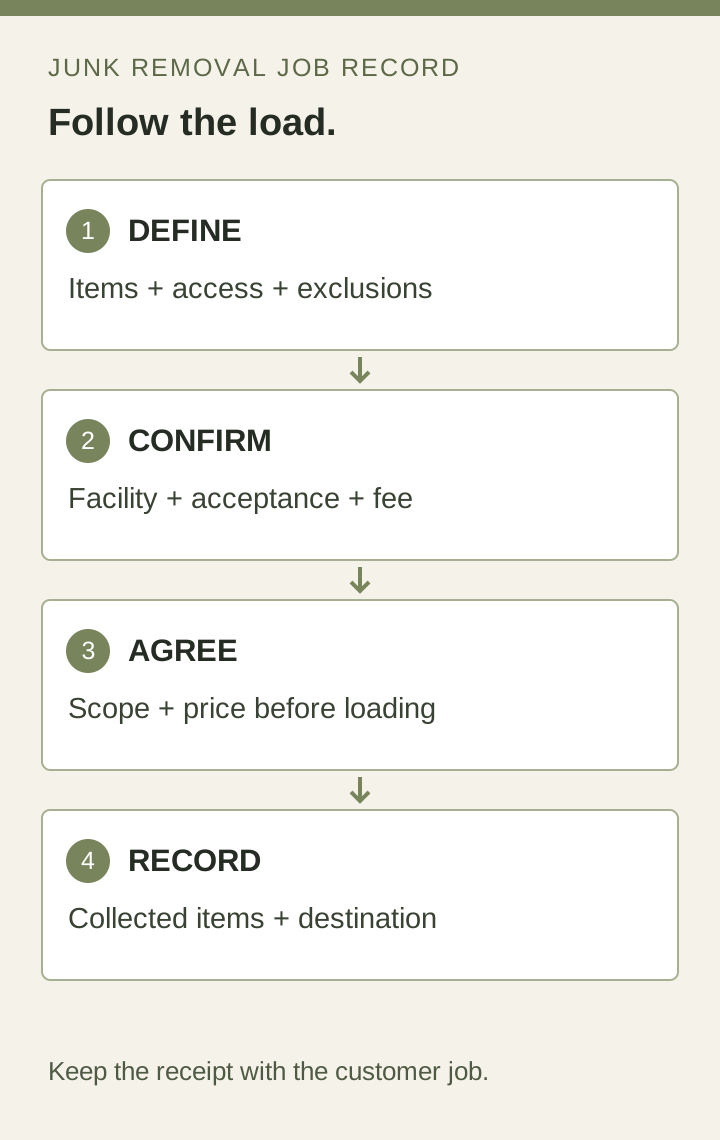
Before loading, confirm the item list, exclusions and price. Mark anything that must stay. Photograph existing damage or difficult access with permission and avoid capturing personal papers or people unnecessarily.
After collection, retain the receiving receipt or other available acceptance record against the job. If a load is split across destinations, record what went where. Track items retained for reuse separately from items actually donated, recycled or disposed of. This makes customer questions answerable without turning an intention into an environmental claim.
The job record should connect four decisions: what the customer authorized, what you collected, what you charged and where the material went. Keep only the personal information needed for the service and protect access to it.
Once a job is complete, ask whether the service matched the agreement and request an honest review. Resolve a complaint by checking the record and responding to the specific issue. A repeatable handover matters more than an ambitious slogan.
Hire for the work you actually need
Write down the duties before recruiting: driving, customer communication, checking the load, safe handling and completing receiving records. Use consistent job-related selection criteria. A friendly conversation alone does not establish someone's ability to do the work.
Provide training for your equipment and procedures, including when to stop. No helper should have to improvise a hazardous pickup to protect a quoted price. Confirm employment, pay, insurance and training obligations for your location before bringing someone onto jobs.
If you use another business for part of a job, agree who handles the customer, material acceptance, transport, insurance and disposal evidence. The subcontract service handoff checklist can help define those responsibilities. Calling someone a subcontractor does not settle their legal status.
Decide whether to expand, stay part-time or join a system
Review completed work before adding capacity. Compare estimated and actual crew time, receiving charges, quote failures, customer issues and the amount left after costs. Separate jobs that paid well because they were easy from jobs you can reasonably expect to repeat.
Moving full-time also has a household cost. Compare reliable business cash after operating costs with your required personal income, taxes and reserves. A busy weekend or gross sales total is too narrow a basis for leaving other work.
Write a concrete description of the service you want to run: accepted jobs, service area, crew responsibilities, response standards and the records each completed job should contain. Test whether someone else can follow those procedures before adding another vehicle or territory.
A franchise may offer a brand and operating system while adding fees, contractual controls and financial exposure. The FTC's U.S. franchise buying guide recommends investigating the disclosure document and speaking with current and former franchisees. Review costs, restrictions and support alongside any permitted financial performance information in Item 19. Check the assumptions behind a claim and how they relate to your proposed operation. Buying into a system is a separate investment decision.
For the first launch, finish a smaller test: confirm the permitted service, receiving route, equipment, coverage and quote process, then complete jobs within those boundaries. Use the records to decide what deserves to grow.