Drone Photography Commission: Questions to Resolve Before Booking
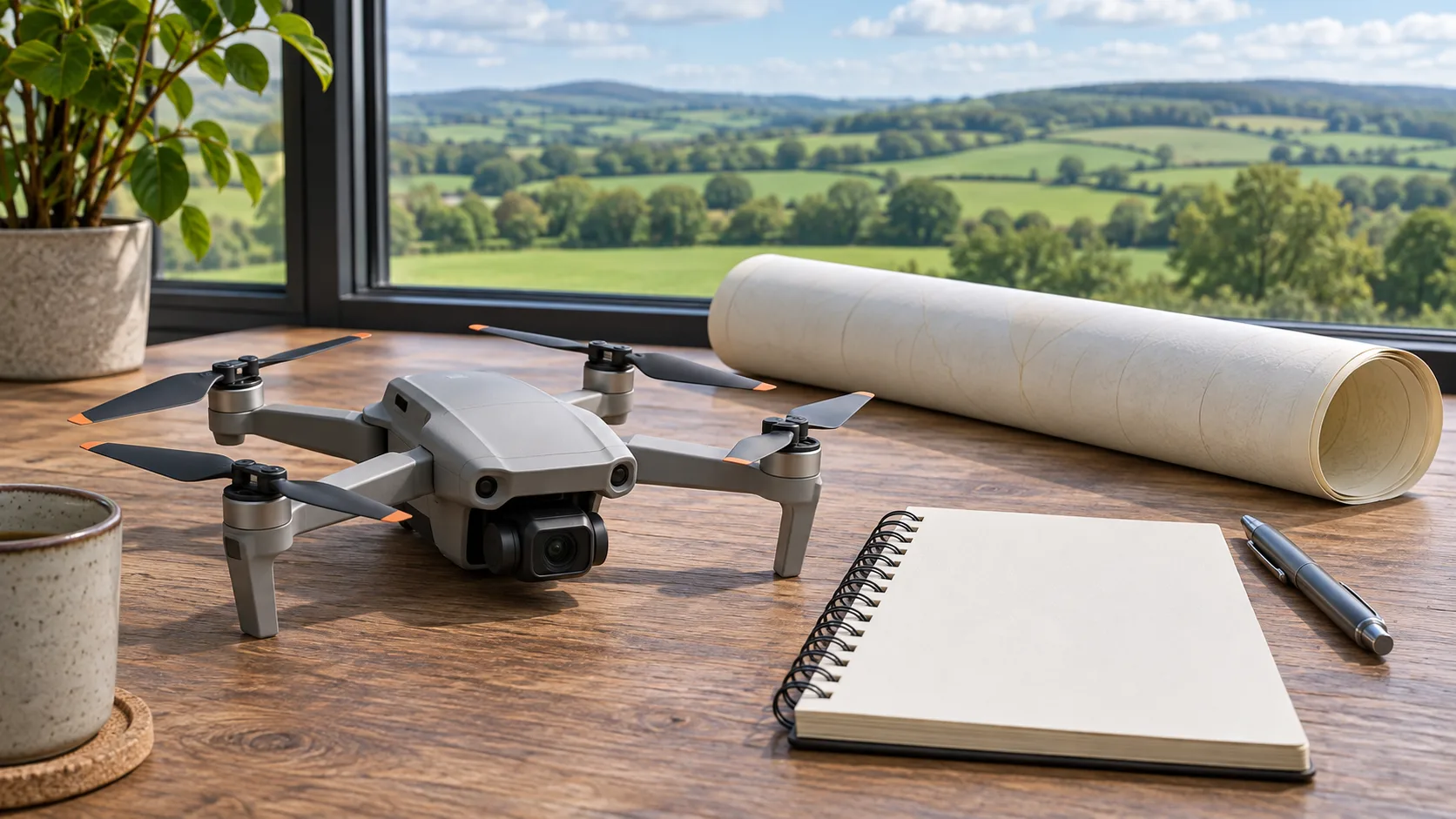
A drone photography request needs a clear image brief and a feasible, lawful flight plan. Before promising footage, establish the location, intended use, access, and who is responsible for checking flight conditions. Side Hustle Nation discusses drone photography and other drone work as possible services; its examples do not guarantee that a particular location or assignment is suitable.
Describe the result the customer needs
Ask whether the customer wants still images, video, or both. List the subject, approximate area, preferred views, output format, delivery date, and any editing included. A request to show a property’s setting is different from a professional inspection: a photograph alone should not be presented as an engineering assessment.
For a fictional farm listing, a client might request a small set of still images showing the approach and surrounding land. The pilot and client first identify the boundaries and decide how to handle visible neighboring property. This illustrates a planning conversation, not an actual flight or proof of permission.
Check the location and authority
Identify the takeoff and landing location and the person able to grant access. Property access does not by itself settle airspace authorization, privacy, or other applicable requirements. The pilot should check the applicable aviation rules, airspace and local restrictions for the proposed date and location, and decline or revise an assignment that cannot be conducted appropriately.
In the United States, the FAA explains that an operator flying under its small UAS Part 107 rule must obtain a Remote Pilot Certificate. The FAA also describes airspace authorization for relevant operations. Rules and exceptions depend on the operation and jurisdiction; these links do not establish permission for a particular flight.
Before accepting a U.S. Part 107 assignment, check that the pilot’s aeronautical knowledge is current. The FAA says pilots must update their knowledge within 24 calendar months using the appropriate online training; this is a currency requirement, not an annual certificate renewal. Also confirm that the aircraft is registered for Part 107 and meets applicable Remote ID requirements. The FAA’s under-250-gram registration exception is for qualifying recreational operations, so do not assume it applies to a paid assignment.
Agree on changes and delivery
Weather, temporary restrictions, site conditions, or safety concerns can prevent a planned flight. Agree on a rescheduling process and any travel or cancellation terms before the appointment. The pilot retains responsibility for deciding whether the flight can proceed safely and lawfully; a customer’s deadline is not an authorization.
Specify how many edited files are included, their format, delivery method, and the scope of use. Discuss whether the client may share images with a listing agent, alter them, or reuse them for another campaign. Do not assume that payment automatically transfers every right. Obtain any necessary permissions before photographing identifiable people or private areas, and consult applicable local rules.
Review before handover
Check the final images against the agreed brief and remove files that inadvertently reveal information the customer did not intend to share. Flag limitations honestly: a missed view is a missed view, not something to fabricate. For related questions about image use, read the stock-photo rights check.