
How to Start a Commercial Cleaning Business: From First Walkthrough to a Sustainable Contract
To start a commercial cleaning business, choose a type of premises you can safely service, inspect it before quoting, and price the full recurring workload. Confirm local business requirements, insurance, building access and payment terms before accepting a contract. Start with a manageable account, record the actual work, and expand when the figures support it.
An office that needs attention after closing can fit around another job. A building that must be ready before your own morning shift may leave very little room for delays. The useful question is whether you can deliver the agreed result, at the agreed time, for a price that covers the work.
This guide covers ordinary office and small commercial-premises cleaning. Healthcare, hazardous waste, specialist kitchen extraction and high-access work need their own competence, procedures and requirements. U.S. agencies are cited where relevant; registration, employment and safety obligations must be checked in the place where you operate.
1. Choose a customer and a service you can repeat
Make your first offer specific enough that a business owner can picture buying it: routine evening cleaning for a small office within a workable service area, for example. Decide which days and hours you can reliably cover before advertising availability.
Commercial and residential cleaning can share equipment, but the buying process and access arrangements can differ. A commercial customer may ask for a purchase order, evidence of insurance, an approved invoice format or a named person responsible for checking the work. A house-cleaning visit has its own expectations about occupied rooms and personal belongings. Neither category removes the need to protect property or agree on responsibility.
Write down your initial inclusions and exclusions. Emptying ordinary bins, vacuuming agreed floors and cleaning specified washrooms might belong in your offer. Carpet extraction, exterior windows, construction debris, pest contamination and handling confidential documents should have separate decisions. Avoid promising to take care of everything in the building.
Also decide whether you want to perform the cleaning yourself or manage a team. Running an account still involves scheduling, supplies, inspections, customer communication and billing when someone else carries out the visit. If you are choosing between those models, compare the responsibilities in solo service work and subcontracting.
2. Walk through the building before setting a price
A floor area alone will not tell you how much work a site needs. Two offices with the same area can have different washrooms, occupancy, furniture density and floor finishes. Ask to inspect the space at a time that shows its normal condition, with permission from someone who can authorize the service.
Use a room-by-room note rather than one broad description:
| Record | What to establish | Why it changes the job |
|---|---|---|
| Rooms and surfaces | Included areas, floor materials, washroom fixtures and restricted rooms | Different surfaces and obstacles require different methods and time |
| Tasks and frequency | What happens every visit, weekly or periodically | A weekly task should not silently become a nightly promise |
| Access and facilities | Working window, alarm procedure, water, power, storage and waste route | Entry, setup and disposal take time too |
| Inspection and exceptions | Who checks the result, how problems are reported, what requires separate approval | Both parties need a clear way to handle missed work and extra work |
Ask what the customer wants to improve about the current arrangement. A complaint about dirty washrooms needs a defined check; a complaint about missed visits needs a coverage plan. Those are different service problems.
Distinguish an initial reset from routine maintenance. If accumulated dirt needs a separate first clean, describe and quote it separately. Otherwise your first visit can consume time that the recurring price never allowed for.
For an unfamiliar surface, get the relevant care guidance and confirm a suitable method before accepting responsibility. If a safe, competent method is unresolved, leave that task out of the quote until it is resolved.
3. Price a commercial cleaning contract from the work
Build an internal cost estimate even if the customer wants a fixed monthly price. Count labor across all workers, travel attributable to the account, setup, supplies, equipment wear, supervision and administration. Include your own cleaning time as a cost. Money left after buying supplies is not automatically profit.
Use this planning sequence:
- Estimate the time for each recurring task and each periodic task.
- Add the non-cleaning work the account creates, including access and inspections.
- Apply your actual labor cost, then add other account costs and a share of business overhead.
- Set a selling price that leaves room for profit and normal variation, and check that it is viable for both parties.
A labor estimate should reflect the staffing arrangement you actually use. When employing people, obtain the relevant payroll, tax, insurance and employment-cost information locally. Your chosen take-home hourly amount is not a substitute for an employer's total labor cost.
A pricing worksheet using your actual inputs
Use the agreed service calendar and your own costs to complete these fields:
| Field | Calculation or evidence |
|---|---|
| Planned visit labor | Visits in the billing period × labor hours per visit × full cost per labor hour |
| Periodic-task labor | Labor hours for tasks due in that period × full cost per labor hour, excluding hours already counted above |
| Other account costs | Attributable travel, supplies, equipment wear and administration, with no duplicated cost |
| Internal cost estimate | Planned visit labor + periodic-task labor + other account costs + allocated overhead |
| Amount above estimated costs | Agreed selling price − internal cost estimate, using a consistent basis for any taxes |
Now test the time estimate: additional labor cost equals visits in the period × extra labor hours per visit × full cost per labor hour. Subtract that amount from what the price leaves above estimated costs. If a small delay removes the room you need, investigate the task timings and scope before accepting the price. That is why recording the work matters more than copying somebody else's monthly quote.
If you quote a fixed monthly amount for a weekly schedule, write how calendar variation, public holidays and closures are handled. Do not assume every month contains exactly four weeks. For labor capacity, a two-person team working for one hour uses two labor hours, even though the customer sees a one-hour visit.
4. Separate the startup budget from the cash buffer
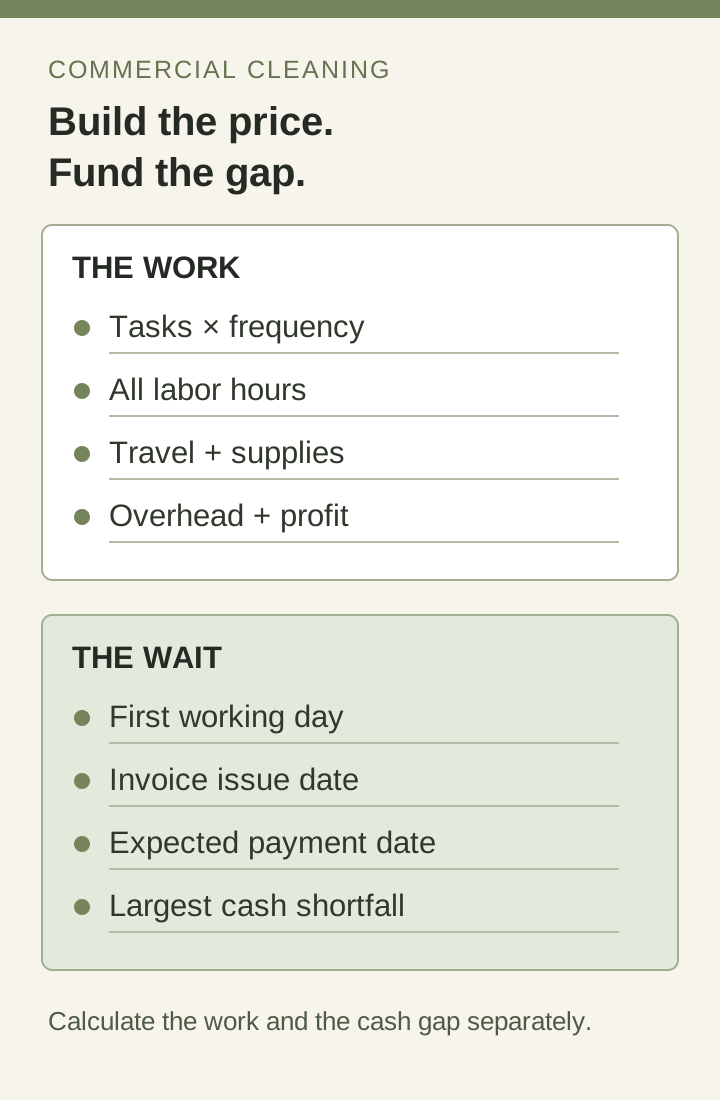
Make two budgets. The first pays for getting ready: suitable equipment, chemicals, protective equipment, training, registration, insurance and whatever administration your business needs. The second pays for operating before customers' money arrives.
Buy against the agreed service. A vacuum, mop system, cloths and labeled chemical containers may be relevant to ordinary office work; a specialist floor machine should have a job and a justified cost behind it. Check maintenance, replacement parts, transport and storage as well as the purchase price. If the customer supplies anything, record exactly what, who replenishes it and what happens when it is unavailable.
Cash timing deserves its own line. When you invoice after the work and the customer has a further payment period, you may need to fund both the work completed before invoicing and the work done while waiting for payment. Wages and supply bills may fall due earlier. Put the actual dates on a calendar and calculate the largest accumulated outflow before expected receipts. Allow for a late payment rather than treating the invoice due date as guaranteed cash.
Agree the billing contact, invoice requirements, purchase order, payment method and dispute route before the first visit. A signed contract and an issued invoice are useful records; neither is money in the bank.
5. Resolve business requirements, insurance and chemical safety
Before trading, identify the registration, tax, licensing and insurance requirements for your location and service. The U.S. Small Business Administration's launch guidance explains that license requirements and fees depend on business activities and location, and describes common insurance categories. It does not establish that your cleaning business is licensed or covered.
Give an insurance professional the actual tasks, premises, staffing and access arrangements you intend to use. Ask about relevant cover, exclusions, property in your care, keys and vehicle use. If a customer requires particular evidence of cover or a bond, obtain and understand the requirement before agreeing to it. A certificate should match the business and work being offered.
Chemical selection belongs in the operating plan. OSHA and NIOSH guidance for cleaning workers discusses chemical hazards, ventilation, protective equipment, labeling, accessible safety data sheets and worker training. Never mix cleaning chemicals. In particular, bleach and ammonia can create dangerous gases. Follow the product instructions and obtain appropriate training for the tasks and hazards involved.
Do not sell a general promise to eliminate every germ. The EPA's disinfectant guidance explains that approved uses and effectiveness depend on the product label, including the target organism, use site and contact time. A surface must remain visibly wet for the specified contact time. Build any agreed disinfection task around the actual label rather than a quick spray-and-wipe assumption.
6. Find first customers without buying every lead
Build a small list of suitable premises within your service area. Look for work that matches your hours and competence, then identify the person who handles the cleaning arrangement. Ask whether they are reviewing suppliers and whether a walkthrough would be useful. Respect site access rules and the recipient's communication preferences.
A useful introduction says what you clean, where you work and which service window you can cover. Your next step is an inspection and a defined proposal. Avoid making a firm quote from a photograph of the building or telling a prospective customer that their current cleaner is doing a poor job.
You can ask existing contacts for introductions, approach appropriate local business groups or use a clear service page. Ask for genuine feedback after completed work, with permission before using a customer's name, photos or testimonial. Do not manufacture reviews to make a new company appear established.
Paid lead services need a separate budget decision. Check the current terms, charges, service area and cancellation arrangements before joining. Track the cost of inquiries against work you actually win and can fulfill. An inquiry is not a contract, and a contract's headline value is not its profit.
Keep a simple prospect record: contact permission, walkthrough date, proposed scope, quote, response and agreed follow-up. Stop when the prospect declines further contact.
7. Turn the accepted quote into a repeatable operation
The accepted scope should identify the site, included work, frequency, working window, price, payment terms, start date and process for changes. Resolve closures, missed access, extra tasks, complaints and ending the arrangement. Obtain appropriate local advice for contract terms where needed.
Use a site record for the cleaning instructions and keep sensitive access information in a separate protected channel. Do not put door codes in a shared job title or leave client keys with an identifying address label. Confirm who may enter and what to do if an alarm or lock prevents safe access.
For the first completed cycle, record actual labor time and any task that was skipped, unclear or outside scope. Compare the result with the quote and discuss necessary changes with the customer. Update the written instructions when a change is agreed. Quietly adding unpaid tasks makes the price model harder to trust.
Choose tools for the records you need: scheduling, an inspection checklist, invoicing and expense tracking. A simple system can be enough at the start if it is accurate and accessible to the right people. Avoid paying for a complex subscription before knowing which problem it will solve.
8. Hire only when the account can support the handoff
Before adding a cleaner, make sure the price can fund the full staffing cost, training, supervision and absence coverage. Teach the site-specific method and check the result. Being present at the building does not prove every agreed task was completed.
Check the working relationship before deciding how to pay people. For U.S. federal employment taxes, the IRS explains that worker status depends on the relationship and degree of control and independence. Calling someone a contractor does not settle the matter. Other applicable employment rules require their own review.
Protect continuity. Record who can cover an absence, how the customer is notified and which jobs you would have to decline if coverage is unavailable. When handing work to another business, make the responsibilities explicit; the subcontracted service scope handoff guide provides a separate starting point.
Is commercial cleaning a workable side business?
It can fit alongside other work when the service windows, physical demands and administration fit your schedule. It becomes difficult when a visit depends on time you cannot reliably protect, a customer needs specialist work you cannot provide, or the payment cycle exceeds the cash you can fund.
Begin with one properly scoped account that you can deliver. Review its real labor, costs, payment timing and complaints before accepting another. Expand because the operation works, with enough room for disruption, rather than because a large contract total looks impressive.